
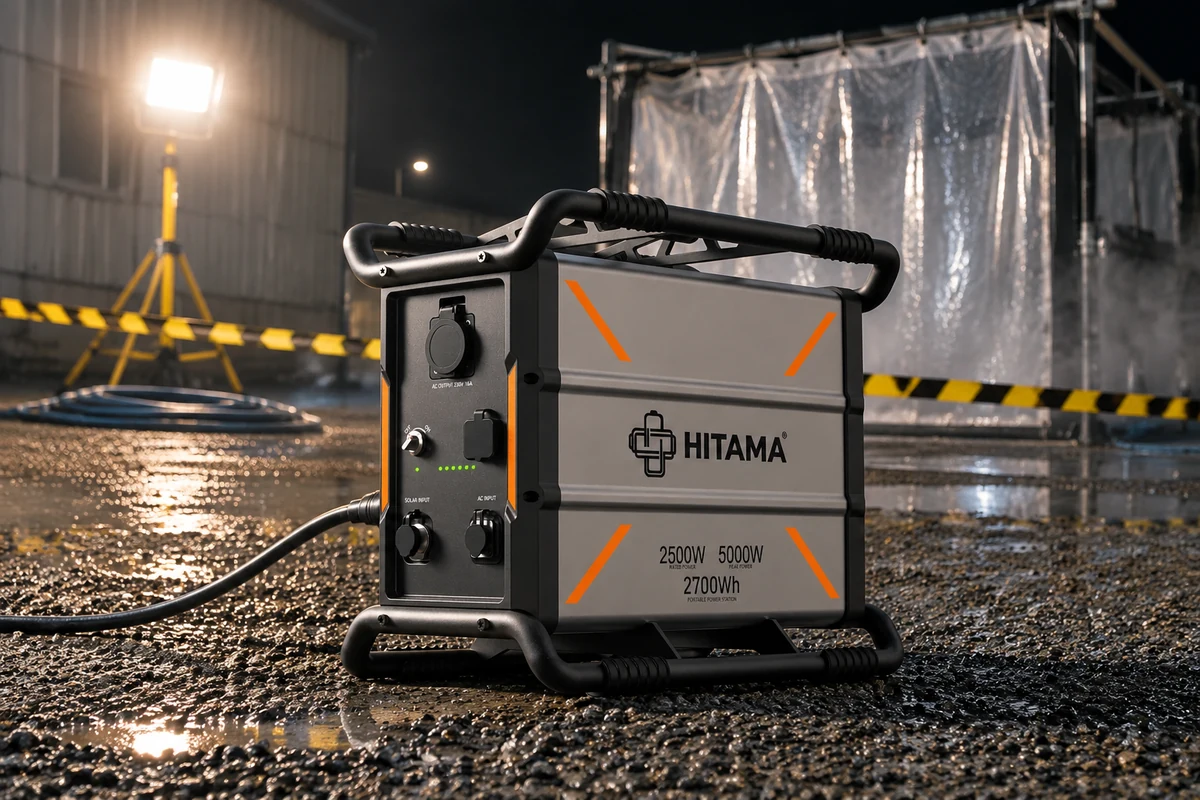
A hazmat scene is drawn as lines people may not cross without being washed. The power cable crosses them in ten seconds, and that crossing is the decision nobody writes down.
The tape goes down before the appliance
Zones are set before anything is plugged in. Cold, warm, hot — the lines are taped while the lane is still being assembled, and every later decision is measured against them.
People leaving the warm zone go through the shower. A cable leaving it does not. It cannot be washed, it cannot be bagged and abandoned, and it must not lie in the run-off being contained downhill.
So the cable is the one object on the scene that crosses a controlled boundary without being decontaminated. Seen that way, the crossing stops being a trip hazard and becomes a control point: one route, marked, off the ground, logged like everything else that comes and goes.
Where the machine stands
Cold side, upwind, out of the drainage path. Not because the unit is delicate, but because anything inside the warm zone is either decontaminated or written off, and a 29 kg machine is on neither list.
No intake, no exhaust, no fan is what makes that position possible. A sealed case does not pull the scene's air through itself — which matters where the air is the reason the scene exists — and it puts no exhaust where a casualty waits to be showered.
IP54 answers splash, not washdown. Two digits cover dust and water; the sump under a lane is neither.
The shower is not the load
A decontamination shower draws almost nothing by itself. A pump, a valve, a work light. On the load list it looks trivial, and it is.
The water is where the energy goes. Heating is resistive, it is continuous, and it begins during setup, because warm water has to be there when the first casualty reaches the lane — in February, before anything else is ready.
That pre-heat is the first load of the incident and it is on nobody's sheet. It starts an hour before the entry control point opens and is still running while the scene is handed over.
Two jobs, two units
One unit on the water, one on the scene. Lighting over the lane, the tablet that logs who goes in, radios and the thermal camera on charge, the feed pump — small, constant, and impossible to interrupt while someone is inside.
Parallel is bought for the crossing, not for the capacity. One to three modules on 230 V single phase, 2,500 W rated and 5,000 W peak each, 2.7 kWh apiece, so the second unit covers what the first is not doing.
Recharge belongs to the handover, not the incident. From a 230 V socket the input draws 500 to 1,500 W, about two hours to 80 per cent and two and a half to full. Nothing mid-scene goes on charge.
Pure sine at THD below 3 per cent is what the tablet, the camera and the radios were built for, and the working window of −10 to 65 °C covers a lane in February and one in August.
What this is not
It is not a decontamination unit. The lane, the shower, the temperature a casualty is washed at, the hygiene standard and the record of who passed through belong to the unit that carries them, not to a power supply on the cold side.
It is not a zone rating, and IP54 is not ATEX. Nothing here classifies an atmosphere or authorises the unit inside a warm zone.
It is not a UPS. No transfer time, no changeover. If the lane must not be interrupted, that is a procedure with a second unit behind it, decided before the scene.
Send the scene — what the shower's heater draws, how many hours it runs before the first casualty, and what else sits on the cold side — and the answer comes back as a placement, a cable route and a count.