
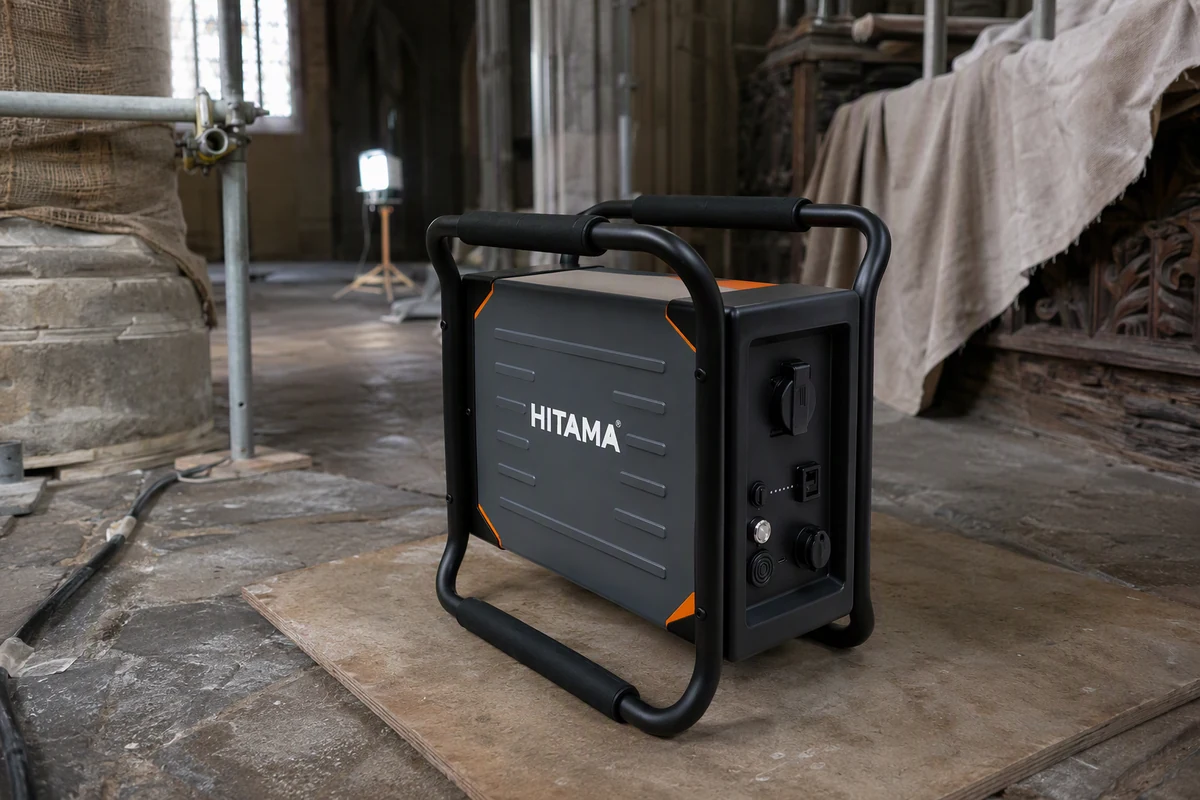
A listed interior does not get a temporary supply installed in it. The power arrives with the tools and leaves with them at night, which reorganises the calculation before any model is chosen.
The consent comes before the load list
Conservation work is governed by what may be fixed, drilled and hung, and the list of things that may not is longer than the list of what may. No conduit in a stone reveal, no trunking along a cornice, no socket cut into old plaster. Cable stops being a length you optimise and becomes a route you are not allowed to leave behind: over thresholds, around the scaffold, taped down and lifted again at the end of the shift.
Most conservation specifications also keep combustion plant outside the envelope, because soot and moisture settle into porous surfaces and stay there. That line removes the generator question before any noise limit would.
A room is a job, not a phase
Programmes are written in rooms, and so is the power. A nave, a side chapel, a vestry and a tower stair are four tasks with four load lists; the total across the building means nothing.
What sizes a unit is the heaviest task in one room, running at once, for as long as that task lasts: a dust extractor on continuous duty, task lighting, small hand tools, a dehumidifier on wet plaster.
C24 is rated 2,400 W and peaks at 4,800 W at 23 kg; P25 is rated 2,500 W and peaks at 5,000 W at 29 kg; P36 is rated 3,600 W and peaks at 20,000 W at 21 to 23 kg — the one for a compressor or a hard-starting extractor. Capacity follows the shift rather than the day: 2.0, 2.7 and 2.1 kWh.
Carrying decides more than capacity
A unit that will not pass a door is not a unit. Door widths, stair turns, threshold steps and how many people are on site decide between 21 and 29 kg more often than a load table does.
The handle frame is for carrying, not for dragging. Set down on a board: a timber floor or a stone flag is no surface to slide 29 kg across, and the case is the heat exchanger, so clearance from fabric belongs to the set-down point. Where the total genuinely passes one unit, one to three modules parallel at 230 V single-phase or 400 V three-phase — decided in the room with the heaviest tool.
Charging is a transport problem
There is no socket in a church, and the cabin socket is three hundred metres and one locked door away. Input draws 500–1,500 W, so the loop is: one shift inside, charge overnight at the compound, back in before the first tool starts. P25 returns to 80 percent in about two hours and full in 2.5; P36 is full in about 1.5.
No intake, no exhaust, no fan, no moving parts means plaster dust is not pulled through the machine and nothing needs stripping before it goes back in the van. Wipe the case and log it.
What the file ends up holding
Every unit leaves the factory through a ten-point test, and the paper that matters here is the plain one. CE under the EMC Directive 2014/30/EU covers electromagnetic behaviour; UN 3480 class 9 packaging covers how it travels. Neither says anything about the building.
What the conservation file wants is a record of what stood in the room, for how long, and that nothing was fixed — a photograph of the set-down point with the board under it. Pure sine wave, THD below 3 percent, IP54, −10 to 65 °C: the numbers to quote when the open question is a control board on a dehumidifier, not a stone wall.
What this is not
Not a permission. Nothing here replaces the conservation plan, the consent conditions or the building's own isolation procedure.
Not an approval for a hazardous area, a confined space or an unattended building. A sealed case removes the exhaust; it does not remove the need for a fire watch, a working alarm or a person who checks.
Send the room list, the heaviest tool in each, the door widths along the route and where the van is parked, and we will say which unit goes in by hand and where it gets charged.