
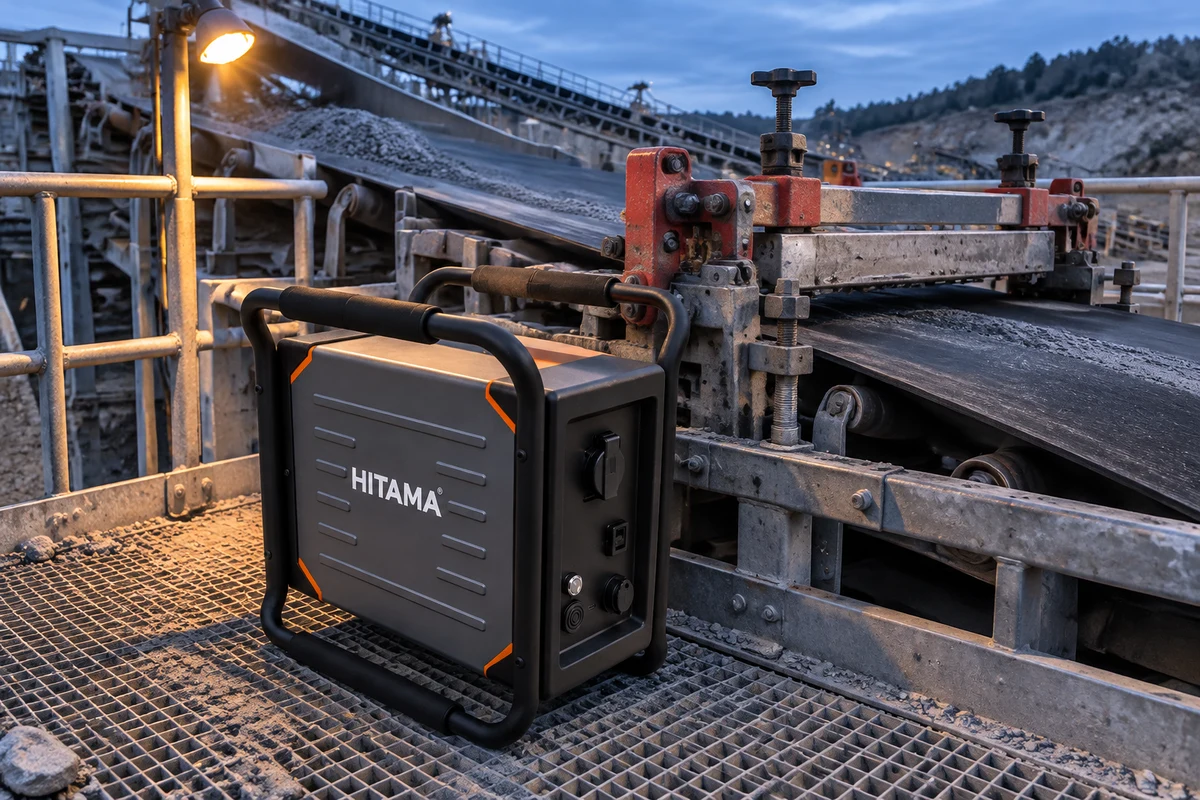
A belt splice is a temperature curve, and a curve that stops halfway has no resume button. A conveyor goes back into service when the splice is cured, not when the last tool is packed away. That moves the power question away from wattage and towards hours nobody stands next to.
The press is a flat load, not a tool
A tool is switched on and off. A press is left alone. The plates come up, the ends are clamped, and the supply then sits behind a load that barely moves for the length of the cure in the belt maker's data sheet.
That length is the only number the supply has to survive — not the belt width, not the tonnage above it, not the peak figure on the press plate. A flat load is easy to feed and hard to interrupt, which is why people size for the interesting part and forget the dull part.
An interrupted cure is a cut-out, not a pause
Half a cure is not half a splice. When the supply drops mid-curve, the belt is cut out, both ends are trimmed again and the press goes back on with a shorter overlap.
Every restart costs belt length. The splice walks further along, the take-up eventually shortens the belt, and the real downtime is the second attempt rather than the first.
Where the press stands decides what you carry
A splice happens where the conveyor is, not where the socket is. Head end, transfer house, bench, top of a gallery — usually far from the site office and further from its supply.
Two people carry 29 kg. P25 is 2,500 W rated and 5,000 W peak from 2.7 kWh in a 29 kg housing, so the route is a staircase question before it is an electrical one.
Three-phase presses take a different walk. P25-T is 7,500 W rated and 15,000 W peak from 8.1 kWh at 400 V three-phase, roughly 90 kg, and the route from the parking point gets walked before the shift. Between the two sits P25-D: 5,000 W and 10,000 W peak from 5.4 kWh at 230 V single-phase, two units at roughly 60 kg.
The transfer house tests the enclosure
A transfer house is a rubber-and-dust room, and there is nowhere to put a machine that draws air through itself. No intake, no exhaust, no fan: the housing is sealed and sheds heat through its walls, so nothing is pulled through it while it stands beside a press filling the room with dust.
IP54 covers splash and dust ingress and nothing more. It is not an area classification and does not make the unit suitable inside an explosive atmosphere — the site's area drawing decides that, not a datasheet. −10 to 65 °C is the window: a cold gallery in February and a black steel structure in July both sit inside it.
Two splices in one shift is a charging question
The second splice inherits the first one's schedule. From an ordinary 230 V socket the input draws 500 to 1,500 W: P25 reaches 80 percent in about two hours and full in two and a half.
So count splices per day, not hours per splice. One run with an evening recharge is comfortable; two runs with a third planned is a charging schedule that belongs in the shift plan. Whoever owns the splice list should own the socket.
What this is not
It is not a press controller. The cure curve belongs to the press and the belt maker's data sheet; the unit holds the supply behind that curve and does not regulate temperature.
It is not plant power and it is not a UPS. It does not replace the fixed installation at the head end, it makes no transfer-time promise, and it must not be wired into a distribution board. It is not a guarantee that the splice passes: a cured joint can still fail a pull test.
It is not certified for a dust zone. CE under the EMC Directive 2014/30/EU and UN 3480 class 9 packaging for sea transport are what the unit holds; an explosive-atmosphere classification is a site document, not a product claim.
Send us the press plate rating, the length of the cure curve and the distance from the parking point to the head end — we will size the array against the belt you actually have to rejoin.