
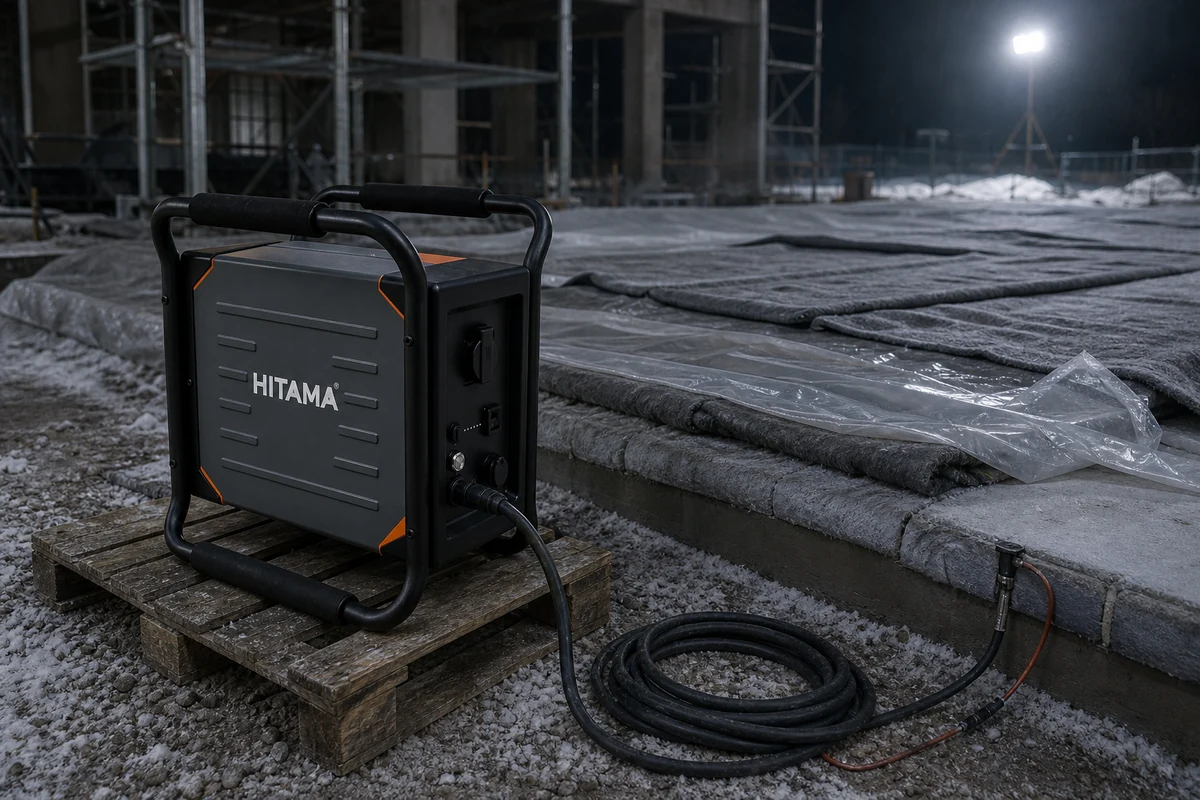
A frost-protection job is not sized by the heater on the hire list. It is sized by the number of nights the pour has to be held above freezing before somebody can reach the site again.
The nameplate is not the night
Every heater on a winter job is quoted in kilowatts, and none of them runs at that figure through a night. A thermostat switches an element: either on at its plate rating or off. What empties a battery is the average of those two states, and that average is printed on no datasheet.
The duty cycle belongs to the weather, not to the machine. A clear night at −6 °C asks more than a damp one at +2 °C, so the same heater on the same slab draws differently on consecutive nights.
So the first instrument on a wrapped deck is a clamp meter. Log one night, note the hours the element was actually on, and sizing becomes arithmetic anybody can check the next morning.
The element has no starting current
A resistive heater is the easiest load a site will ever present: no inrush, no surge, no thermal trip waiting for the coldest morning. The column that fits is the rated one — P25 at 2,500 W, P36 at 3,600 W; the peak column, 5,000 W and 20,000 W, exists for motors and tools.
The heater's supply decides the unit before its rating does. Most site heaters are 230 V single-phase; slab systems are often wired 400 V three-phase, and no single-phase unit covers those. P25-T combines three modules into 400 V three-phase: 7,500 W rated, 15,000 W peak, 8.1 kWh.
The interval decides the capacity
Capacity is the easy half. The gap between two visits is the hard one. A pour on Thursday with a daily walk needs one night of energy. A pour on Friday with nobody back before Monday needs three, and the third night chooses the model.
Recharge belongs to the same sum, and only when a socket exists. From 230 V the input draws 500–1,500 W: P25 reaches 80 percent in about two hours and full charge in 2.5, P36 in about 1.5. Without a socket until Monday the charger is not part of the answer; only what left the depot full counts.
One night is a small unit's job; three nights is not. C24 carries 2.0 kWh at 23 kg, P25 2.7 kWh at 29 kg, and P25-D 5,000 W and 5.4 kWh around 60 kg on a trolley — the second module is usually paid for by Saturday, not by the element.
Where the unit stands
−10 to 65 °C is the working range, and frost work sits comfortably inside it. What goes wrong is not the air temperature but the temperature around the casing: no fan, no intake, heat leaves through the shell, so clearance is part of the installation.
Under a tarpaulin that clearance becomes a decision. A sheet two centimetres from the side is not shelter, it is a greenhouse; so are straw bales against the frame.
IP54 is splash protection, and a thawing slab is a wet floor. Pallet under the unit, front face out of the melt line, connectors off the ground. Certifications are CE under the EMC Directive 2014/30/EU and UN 3480 class 9 packaging for sea freight; IP54 is not submersion, and no Ex rating is claimed.
What this is not
It is not a curing specification. Temperature, mix design, insulation and the required regime belong to the engineer who signed the pour. A unit holds a heater on; it certifies nothing about the concrete.
It is not a substitute for covering the slab. Power does not insulate, and a heater under open sky is a budget with no bottom.
It is not a fixed installation. It feeds its own outlets, has no changeover, and cannot be wired into the site distribution.
It is not a combustion appliance, which is the point of putting one inside a sealed wrap. Nothing is drawn in and nothing is exhausted into the enclosure.
Send the load list — plate rating and supply of every heater, a measured duty cycle if you have one, the nights between site visits, whether a 230 V socket exists for recharging, and the temperature inside the wrap. We will size the configuration against those numbers and tell you where it stops.