
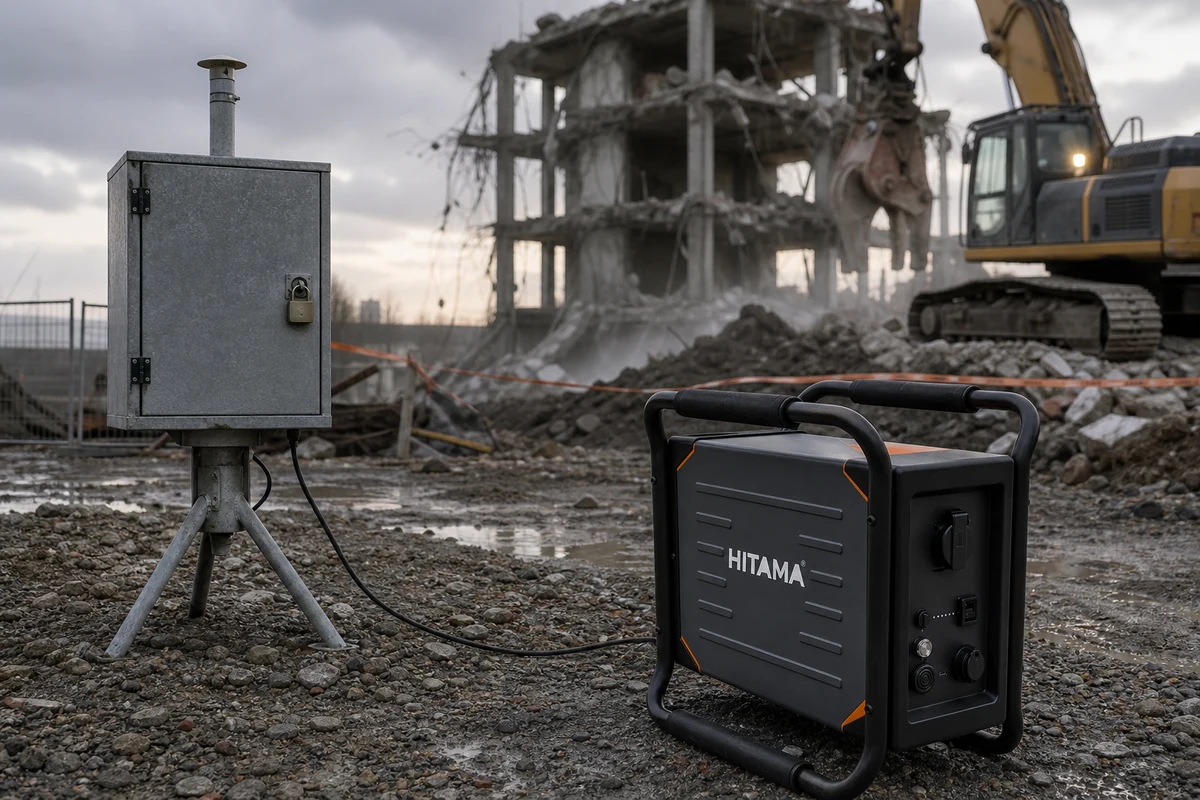
A drill fails loudly. A dust monitor fails quietly, and the silence arrives as a gap in a series somebody will read months later.
The load nobody watches
A monitoring station is the only load on a demolition site that never asks for anything. The breaker announces itself, the pulveriser announces itself. The enclosure at the fence line draws a few watts, writes a number every few minutes and sends it away; nothing about it is audible from the cab.
That is why its supply gets decided last. After the welfare cabin, after the site lighting. What remains in the programme is a socket that does not exist and a date the first measurement is due.
The consequence is not a stopped tool. A stopped tool costs an hour. A series with a hole in it costs an argument you cannot win, because the missing days are the ones that mattered.
What October changes
The winter load is not the sensor. It is the inlet. A monitor sampling humid air needs its line held above the dew point, or water condenses in the tube and the reading drifts before it stops arriving. That heater runs through the night, the weekend and the fortnight nobody opens the cabinet.
So the sizing month is January, not July. A station measured in summer looks like a five-watt problem. In January it is a different number, and the difference is a resistive load with no interest in your programme.
The enclosure is the second variable. A steel cabinet in direct sun is not at ambient, and the window for the unit itself is −10 to 65 °C.
The changeover is the design
Almost nobody fails because the battery is too small. They fail because the swap was written into a schedule that does not exist. Capacity is the easy half; the interval is the hard one, and the interval is a question about walks that already happen on site.
Size to the round, not to the maximum. If the site is inspected weekly, a unit that runs a month only has to survive between two of them. The C24 carries 2.0 kWh, the P36 2.1 kWh, the P25 2.7 kWh, and charging draws 500-1,500 W from a 230 V socket, so a unit takes a shift charge at the office rather than being fed inside the enclosure.
An intake is the wrong answer here
The fastest way to shorten a battery's life in a demolition zone is to give it a fan. Air cooling means an intake; an intake in a dust enclosure means a filter that loads, a fan that stalls and a thermal path that depends on something you cannot see. This body has no intake and no fan: sealed, heat leaves through the casing, IP54.
The record has no comma
A series cannot be paused politely. There is no notation for "the site was quiet, but the instrument was off". The changeover is manual and written down: who removes the discharged unit, who fits the charged one, who covers the week that person is on leave.
Write it on paper. A changeover that depends on an app nobody opens is a changeover that gets skipped, and October is when it gets skipped.
One written line is enough. A date, a name, a signature. The series only has to be continuous, not elegant.
What this is not
It is not a monitor. It does not measure, log or certify anything; the instrument does that. It is not a remedy for a badly sited enclosure — if the cabinet cooks, more power will not rescue the measurement. It is not a claim that every heated inlet runs from one unit: the inlet's nameplate and starting behaviour decide that. It is not an alternative to a live supply where one exists. The CE marking refers to the EMC Directive 2014/30/EU and says nothing about your monitoring obligation; UN 3480 class 9 covers packaging for sea transport.
Send us the enclosure schedule and the instrument nameplates. We will work out the changeover interval with you, before the first measurement is due rather than after the first gap.